

Beyond Caregiving: Living Fully While Caring for a Partner with Dementia


"Sometimes all we can do is put our life and our plans on hold to care for others."
Can we have a quick tough love, honest moment?
The above statement is terrible, terrible advice. It's well intentioned though, right? But, it's just not good advice and every time I hear it I cringe a little bit inside — oof! You should never put your life on hold. If I can be even more frank, putting your life on hold is probably one of the worst decisions you could ever make in general, but especially as a caregiver. There is literally no promise to our days. Yet, we often treat life as if we have all the time in the world, as if all we need to do is suffer through and then we can resume living when it's all said and done — perhaps, or perhaps not.
Did you know that 30-40% of caregivers will die before the person they are caring for? Some estimations are even as high as 60%! Why? Because caregivers are often under chronic stress and if we are being honest, don't prioritize their health. Sometimes, putting their "life on hold" extends to caring for their physical and emotional body as well, not just getting out the house and living life. Therefore, it ends up being a form of death due to "self-neglect" — not caring for the mind, body, and soul because of a decision that was made to "put their life and their plans on hold to care for others." One study even found that 1 in 17 caregivers of persons with dementia died by suicide. I don't think that is coincidental.
Please don't let this be you! You can still live your life and do many, many things you're wanting to do! It may just look a little bit different and require more thought and planning to execute. However, the first thing you must do is change your mindset around being a caregiver...and being caregiver to someone living with dementia. This is why I love the term care partner. Understandably, not everyone loves the term care partner. However, the true difference between a caregiver and a care partner does not lie in semantics. It lies in mindset. This is a big piece that often goes overlooked. When you view your relationship with the person you are caring for as a partnership, you will quickly learn how to reframe many of the situations you encounter. Many people will say that the dynamic between a caregiver and a person with dementia is not a partnership because a partnership implies that the contribution to the life and the relationship is equal, 50/50. But, this isn't true...a partnership is 100/100, meaning that each person is giving what they are able to give, at the time they are able to give it — 100. When we sit back and think about it, isn't that how most good relationships are — a partnership of everyone giving what they can, when they can? And, guess what!? This can look different and fluctuate every day. Realistically, it not always going to look like a true "100%". It's based on best effort possible, which could be 60% for that moment in time (but it's still 100 of what the person has to give).
It's important to realize a person with dementia is doing the best they can every single day. This best may look like 75% one day and 45% the next day. Same will hold true for you. One day your best may look like 85% and the next its 60%. That's life — full of ebbs and flows. So, how can everyone's contribution of best effort be used to improve the journey of life together? When you stepped into the role of caregiver, did you not join your partner on their journey? Did they not simultaneously become a part of yours? So, embrace the beauty that lies in viewing your life with the person you are caring for as a partnership. You are both in this together!
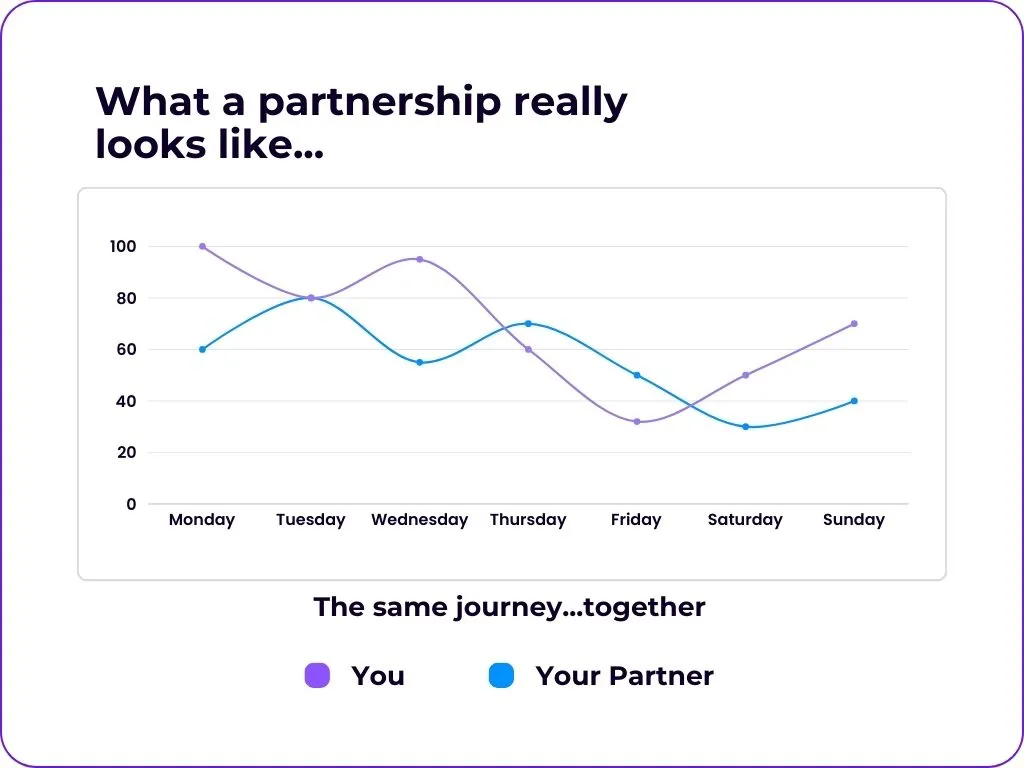
I say that all to say, you must reframe what life CAN look like...together. Will you have to make some sacrifices? Well, yes! Any partnership will require some sacrifices. But, to your surprise, there may not be as many as you think.
So, if you are feeling up to it, let's do an exercise! You can download and print the template here or use a couple sheets of paper.
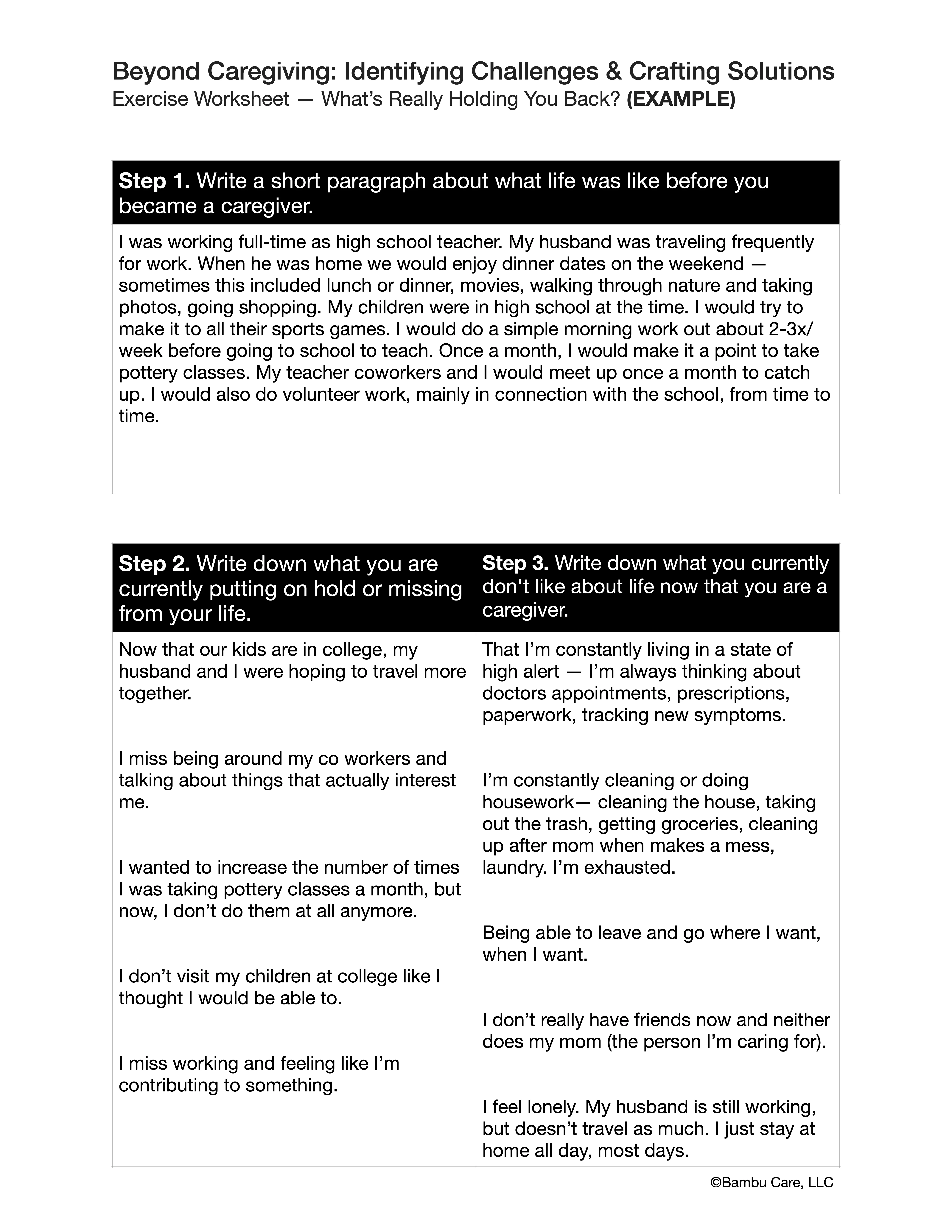
Step 1. Write a short paragraph about what life was like before you became a caregiver.
Step 2. Write down what you are currently putting on hold or missing from your life.
Step 3. Write down what you currently don't like about life now that you are a caregiver.
(Don't filter yourself. Let it out and write it all down.)
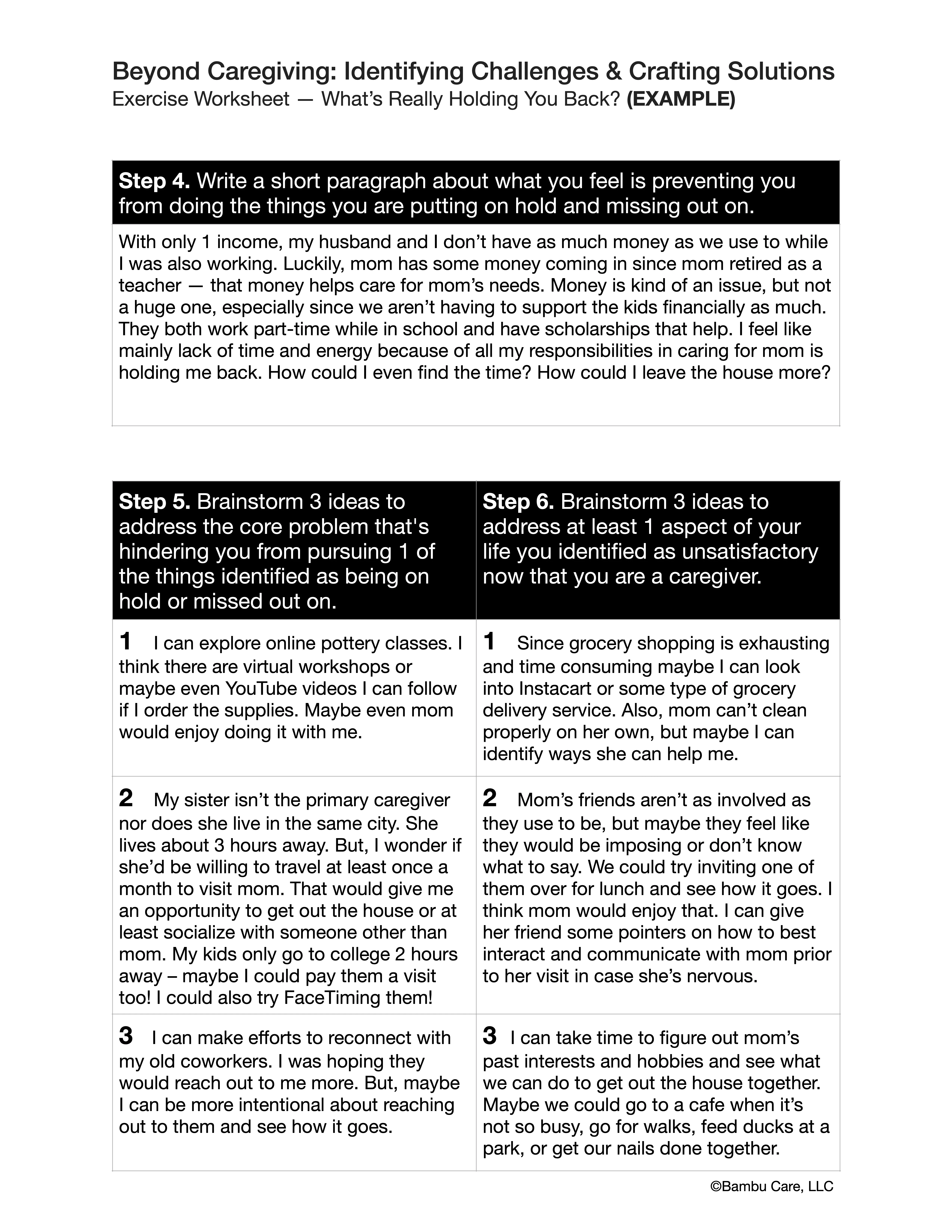
Step 4. Write a short paragraph about what you feel is preventing you from doing the things you are putting on hold and missing out on.
Step 5. Brainstorm 3 ideas to address the core problem that's hindering you from pursuing at least 1 of the things identified as being on hold or missed out on.
Step 6. Brainstorm 3 ideas to address at least 1 aspect of your life you identified as unsatisfactory now that you are a caregiver.
The key to living a full, still enjoyable life lies in mastering the art of problem solving. Life is just a bunch of problems and solutions. Some problems may be bigger than others, but it is by addressing these problems that both you and your partner can continue to lead fulfilling lives. The truth is, both the caregiver and the individual with dementia inadvertently face limitations due to circumstances, but they can be overcome. So many opportunities are often dismissed automatically. Your task is to get clear on the true problem and then solve for the problem. Okay?
Let me show you what this exercise may look like once completed.
Please don't just settle for the cards life hands you. Play your best hand, push the boundaries, and change the rules if you must. Take control of your circumstances and make the best out of them, even if they're not ideal. And, I don't say this to make it sound easy. I say this to make it sound POSSIBLE!


Leave us a review.
We love hearing from you.
Every review helps us reach and help more caregivers like you.